Heaps
Heaps are based on the notion of a
complete tree,
for which we gave an informal definition earlier.
Formally:
A binary tree is
completely full
if it is of
height,
h, and has 2
h+1-1 nodes.
A binary tree of height,
h, is
complete iff
- it is empty or
- its left subtree is complete of height h-1 and its
right subtree is completely full of height h-2 or
- its left subtree is completely full of height h-1 and its
right subtree is complete of height h-1.
A complete tree is filled from the left:
- all the leaves are on
- the same level or
- two adjacent ones and
- all nodes at the lowest level are as far to the left
as possible.
Heaps
A binary tree has the
heap property iff
- it is empty or
- the key in the root is larger than that in either
child and both subtrees have the heap property.
A heap can be used as a priority
queue: the highest priority item is at the root and is trivially
extracted.
But if the root is deleted, we are left with two sub-trees
and we must
efficiently
re-create a single tree with the heap property.
The value of the heap structure is that we can both extract
the highest priority item and insert a new one in O(logn)
time.
How do we do this?
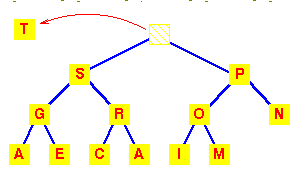
Let's start with this heap.
A deletion will remove the T
at the root.
|
 |
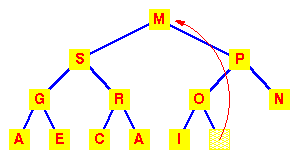
| To work out how we're going to maintain the heap property,
use the fact that a complete tree is filled from the left.
So that the position which must become empty is the one
occupied by the M.
Put it in the vacant root position.
|
 |
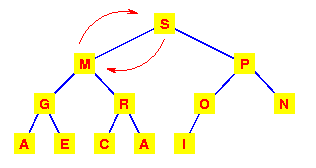
| This has violated the condition that the
root must be greater than each of its
children.
So interchange the M with the larger
of its children.
|
 |
| The left subtree has now lost the
heap property.
So again interchange the M with the larger
of its children.
|
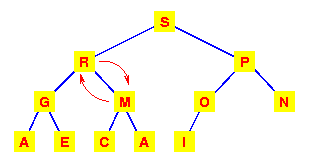 |
This tree is now a heap again, so we're finished.
We need to make at most
h interchanges of a
root of a subtree with one of its children to
fully restore the heap property.
Thus deletion from a heap is
O(h)
or
O(logn).
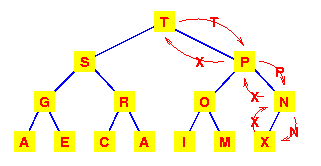
Addition to a heap
To add an item to a heap, we follow the reverse
procedure.
Place it in the next leaf position and
move it up.
Again, we require O(h)
or O(logn)
exchanges.
|
 |


Comments
Post a Comment